

Dame Elisabeth Frink made Dorset her home for the last sixteen years of her life. It was always her wish that her sculpture be displayed in a natural setting and preferably in the county she had adopted as her own.
It is hoped that Sherborne House will one day be able to provide public access to her work and archive. Frinks work can currently be seen at Bournemouth University which has an .
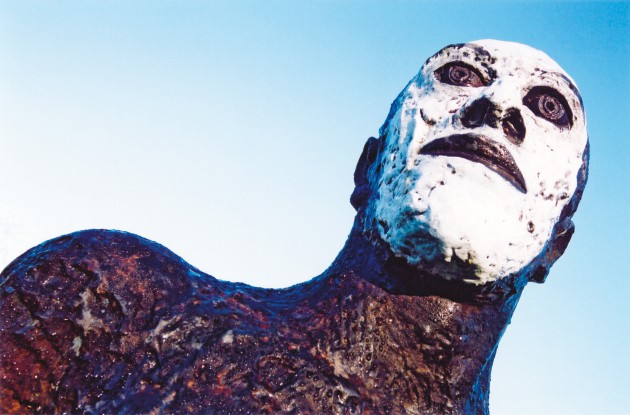
Born in Suffolk in 1930, Dame Elisabeth’s father, Ralph, was an officer in the 7th Dragoon Guards and late of the renowned Indian Army cavalry regiment, Skinner’s Horse. She learned to ride before she was four, adored being outside with horses and dogs and learned to shoot before she was five. All very military and county, perhaps, except that same love of nature, of horses and dogs – of being at home in what was then seen as very much a man’s world – and her uninhibited fascination for ‘maleness’ itself would later illuminate and inform her artistic life.
She attended Guildford School of Art, followed by Chelsea School of Art and had her first major exhibition at the Beaux Arts Gallery in London, when she was only twenty-two. The occasion was marked by the Tate Gallery purchasing ‘Bird’. Thereafter Dame Elisabeth went from strength to strength. Some of her best known sculptural works are ‘Eagle’, installed at the JFK memorial, Dallas, Texas; ‘Water Buffaloes’, for the Hong Kong Land Company; the famous ‘Goggle Head’ series; a commission for Paternoster Square by the City of London, featuring a flock of sheep (which subsequently seems to have gone missing); ‘Warhorse’, on display at Chatsworth; and ‘Risen Christ’, for Liverpool Cathedral.
In later years Dame Elisabeth produced a series of stunning portraits, including those of Sir George Solti and Sir Alec Guinness. She also illustrated Homers’ ‘Odyssey’ and ‘Iliad’ for the Folio Society; ‘Aesop’s Fables, published by Alastair McAlpine and Leslie Waddington; and a series of etchings taken from the Canterbury Tales, again published by Leslie Waddington. The latter caused some comment for their frank portrayal of the sex act. Dame Elisabeth was an artist who never lost her earthy appreciation of life.

She exhibited throughout the world and had honorary doctorates from the universities of Warwick; the Open University; Cambridge; Exeter; Oxford; Keele; Manchester and Bristol and a full doctorate from the Royal College of Art. Awarded the DBE in 1982, Dame Elisabeth was a Trustee of the British Museum; a member of the Royal Fine Art Commission; and Trustee of the Welsh Sculpture Trust.
Conventional yet controversial, Dame Elisabeth’s art was groundbreaking. Her work was untouched by passing fashions and she was uncompromising in her pursuit of perfection. Soon after completing ‘Risen Christ’, Dame Elisabeth died of cancer at home on the 18th of April 1993.
Visit the Elisabeth Frink Estate website .
 Return to Home